
Guide To Repairing Concrete Cracks
Like death and taxes, concrete cracks are unavoidable. As expected, concrete crack repair is a very common task for homeowners and property mangers alike. Cracks in concrete can be caused by a variety of factors, including weather, foundation settlement, and improper installation. Some concrete cracks are minor and do not pose a serious problem, while others can be more serious and require repair. Although there is no shortage of professional crack repair companies eager to assist you, repairing concrete cracks is well within the abilities of even the most novice do-it-yourselfer.
How To Save Yourself Serious Money On Crack Repair
Hiring a contractor to repair a foundation crack can be expensive ($500 – $1,200 per 8-10 ft.) but surprisingly anyone can repair concrete foundation cracks. Whether repairing cracks that leak or merely for appearance, our comprehensive line of crack repair kits are designed for permanent concrete repairs! Professional-quality, high-strength materials for contractors, but easy enough to use for a homeowner.
How To Choose the Best Concrete Crack Repair Kit
The best concrete crack repair kit, is the one that is designed specifically for the type of crack you need to repair. The truth is, there is no magic concrete crack repair material thats best in all situations. Whether you have leaking cracks in your poured or block foundation walls, or cracks in your concrete slab, RadonSeal offers the widest selection of advanced concrete crack repair materials for permanent repairs. Waterproofing? Radon mitigation? We’ve got your covered. Since 1997, our products have helped customers repair cracked and spalling outdoor concrete, as well as interior concrete cracks, floor-to-wall joints, contraction joints, pipe protrusions, and more. The chart and material information below will help you better understand how to select the proper concrete crack repair kit for your problematic crack.
Sealing Cracks is not always Cut-and-Dry – We offer a comprehensive line of concrete repair kits for waterproofing professionals and homeowners alike with no-fuss ease of use. Our expert application consultants will help you make the right product selections to meet your specific requirements. If you wish to discuss an application or have any questions regarding your particular project feel free to contact us to speak with a service technician. Call today, at 1-800-472-0603 or email us your questions.

Surface Area
Crack Type
Select Kit

Poured Concrete Walls
Cracks (<1/2″)
Hairline Cracks
Corner Cracks
Pipe Penetrations
Large Cracks (>1/2″)
Wire & Form Ties
Large Holes & Voids
Cold Joints | Seams
Honeycombed Concrete
DIY Foundation Repair
DIY Foundation Repair
DIY Foundation Repair
PipeTite
ElastiPoxy
uPLUG
ElastiPoxy
DIY Foundation Repair
ElastiPoxy

Concrete Floors & Slabs
Cracks (<1/2″)
Hairline Cracks
Large Cracks (>1/2″)
Cove / Floor-to-Wall Joints
Expansion Control Joints
Holes & Spalls
Pipe Penetrations
CrackWeld
CrackWeld
ElastiPoxy
ElastiPoxy
ElastiPoxy
ElastiPoxy
PipeTite

Concrete Block Walls
Cracks
Mortar Joint Repair
Holes & Voids
Pipe Penetrations
ElastiPoxy
ElastiPoxy
ElastiPoxy
PipeTite

Industrial, Slab-On-Grade
Cracks (<1/2″)
Wide Cracks (>1/2″)
Control Joints
Spalls, Pit Marks, Holes
CrackWeld
ElastiPoxy
ElastiPoxy
ElastiPoxy
Poured Concrete Walls
| Crack Type | Select Kit |
|---|---|
| Cracks (<1/2″) | DIY Foundation Repair |
| Hairline Cracks | DIY Foundation Repair |
| Corner Cracks | DIY Foundation Repair |
| Pipe Penetrations | PipeTite |
| Large Cracks (>1/2″) | ElastiPoxy |
| Wire & Form Ties | uPLUG |
| Large Holes & Voids | ElastiPoxy |
| Cold Joints | Seams | DIY Foundation Repair |
| Honeycombed Concrete | ElastiPoxy |
Concrete Floors & Slabs
| Crack Type | Select Kit |
|---|---|
| Cracks (<1/2″) | CrackWeld |
| Hairline Cracks | CrackWeld |
| Large Cracks (>1/2″) | ElastiPoxy |
| Floor-to-Wall Joints | ElastiPoxy |
| Control Joints | ElastiPoxy |
| Holes & Spalls | ElastiPoxy |
| Pipe Penetrations | PipeTite |
Concrete Block Walls
| Crack Type | Select Kit |
|---|---|
| Cracks | ElastiPoxy |
| Mortar Joints | ElastiPoxy |
| Holes & Voids | ElastiPoxy |
| Pipe Penetrations | PipeTite |
Industrial
| Crack Type | Select Kit |
|---|---|
| Cracks (<1/2″) | CrackWeld |
| Wide Cracks (>1/2″) | ElastiPoxy |
| Control Joints | ElastiPoxy |
| Spalls, Pit Marks, Holes | ElastiPoxy |
Most Recent Reviews Online
The Wrong Way To Repair Concrete Cracks
Concrete Caulk Does Not Last Forever – The typical homeowner will attempt a stopgap by filling concrete cracks with silicone caulk, but this is a superficial repair. Water will fill the inside void of the crack can cause efflorescence, which will eventually loosen the caulk. It is not uncommon that years later, the caulk will lose its bond and begin peeling.
Do Not Use Hydraulic Cement – Disappointed, the homeowner will remove the caulk, chisel out the crack, and fill it with hydraulic cement. However, hydraulic cement has a weak bond with concrete, which is the reason the crack needs an inverted V-groove to hold it in. Additionally, hydraulic cement is very rigid. As concrete continuously moves, shrinks, and expands, the rigid “rod” will loosen. Efflorescence (“white powder”) will begin to purge, soon followed by drops of water or signs of moisture. After a couple of years, water will begin to leak around it.
An alternative foundation repair method is to excavate and patch the crack on the exterior. This may not be permanent because all surface repairs will eventually get loose or crack.
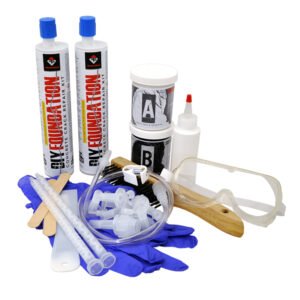
DIY Foundation Wall Crack Repair Kits | 8-10′
The Ideal Repair Kit for Homeowners – RadonSeal DIY Foundation Crack Repair Kits are designed for waterproofing common settling cracks in poured concrete walls. Polyurethane foam injection is not recommended for use on concrete block walls (CMU) because of its hollow cores. Successfully repairing basement wall cracks can easily be achieved from the inside/out. This avoids the need to excavate the outside of the foundation, saving homeowners serious money. Our repair kits use a low-viscosity, two-component urethane that is suitable for filling hairline cracks, as well as wide cracks (up to ½”). Low-pressure concrete crack injection works by filling the entire length and depth of the crack with expandable, hydrophobic polyurethane foam (reacts with moisture; expands up to 35x its volume). Once the repair is complete, the crack is filled with a flexible urethane foam that will block groundwater leaks, radon gas, and insects.
- PRO TIP > If structural strength is required, use the injectable Epoxy version of these kits. Epoxy does not expand and if there is a void, will run out of the back of the crack.
Common Use: hairline cracks, poured concrete walls, leaking foundation cracks, mortar cracks in stone foundations, radon prevention
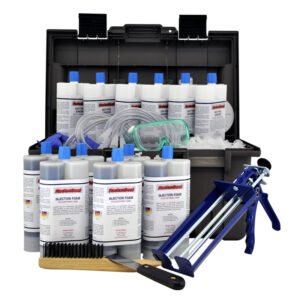
PRO Concrete Crack Repair Kits | Urethane/Epoxy | 30-60′
The Complete Kit for Waterproofing Contractors – Like our DIY Kits, the professional toolkits use expandable polyurethane foam and/or a rigid injectable epoxy. Our PRO Crack Repair Kits include a dual-caulking gun, making injection easier and the epoxy surface seal cures much faster in comparison to the surface seal for our DIY Kits (less waiting). The expandable urethane foam adheres tenaciously to dry and wet surfaces, it is suitable for both dry and wet cracks. Its low viscosity (100 cps) and forceful expansion on contact with water make it suitable for both hairline or wide cracks. Replacement kits, materials, and accessories are available, as well as special surface sealers and injection polymers needed by contractors.
Common Use: basements, multiple cracks, dams, commercial buildings, industrial structures, poured concrete, foundation cracks
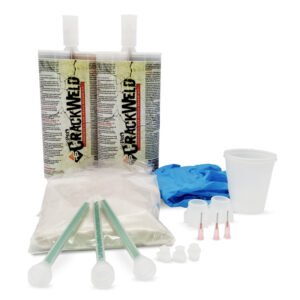
CrackWeld DIY & PRO Concrete Floor Crack Repair Kits
No Routing or Drilling Required – CrackWeld DIY & PRO Concrete Floor Repair Kits are designed for flooring contractors, but can be easily used by homeowners. CrackWeld is able to fill the full depth of hairline and wider cracks in indoor or outdoor concrete slabs with a rigid, fast-curing, low-viscosity resin. It cures stronger and harder than the concrete itself (5,000 psi). Ready for paint, epoxy, overlays, vehicular and foot traffic in under 30-minutes.
Common Use: hairline cracks, basement floor, concrete floors, garage floor, concrete driveway, sidewalks, commercial floors
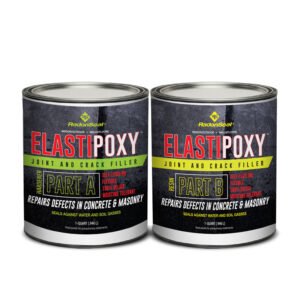
ElastiPoxy Control Joint & Crack Filler Kit
Ideal For Repairing Leaking Floor-To-Wall Joints – ElastiPoxy Joint & Crack Filler Kit protects floor-to-wall joints (cold joints) and control joints against heavy vehicular traffic while allowing for the natural movement of concrete. ElastiPoxy is also used to fill cracks in concrete slabs and concrete blocks that require a strong, rigid repair. ElastiPoxy is a self-leveling filling epoxy, but alternatively can be mixed with dry construction sand to provide a super strong and rigid repair. The resin bonds tenaciously and cures stronger than the concrete itself (8,000 psi).
Common Use: floor-to-wall joints, cracks in concrete blocks, wide cracks, expansion control joints, spalling, warehouse floors, parking garage, cold joints
PipeTite – Pipe Protrusion and Gap Filler Kit
Common Use: voids around pipe penetrations through foundation walls, wire ties, short foundation cracks
Foundation Pipe and Protrusion Leak Repair Kit – Similar to our DIY Concrete Crack Injection Kits, PipeTite will permanently prevent water leaks by expanding and filling voids around pipe penetrations and/or through leaking wire ties. The PipeTite Kit reacts with moisture/water and fills the entire void with an expandable, strong-bonding, high-grade, polyurethane foam.
Material(s) Needed: Standard/Single cartridge caulking gun
Coverage: 5-7 wire ties, 3-5 pipe penetrations